QUICK ANSWER
Dussehra, also called Vijayadashami, marks the triumph of good over evil and falls on the tenth day of the Hindu month of Ashwin (September–October). It commemorates Lord Rama’s victory over the demon king Ravana in North India, and Goddess Durga’s victory over the buffalo demon Mahishasura in East India — two parallel traditions celebrated under one festival name. Understanding these ten facts gives students a well-rounded view of one of India’s most significant cultural and religious festivals.
Dussehra: Key Facts at a Glance
| # | Fact | Why It Matters |
|---|---|---|
| 1 | Marks the end of Navratri (nine nights of worship) | Connects Dussehra to a larger nine-day festival cycle, not a standalone event |
| 2 | Falls on the 10th day of Ashwin (Ashwin Shukla Dashami) | Determines the shifting Gregorian calendar date each year |
| 3 | Two major legends: Rama vs. Ravana and Durga vs. Mahishasura | Explains regional variation in how the festival is celebrated |
| 4 | Ravana Dahan (effigy burning) is the most iconic ritual in North India | Symbolizes the destruction of evil, ego, and arrogance |
| 5 | Ramlila performances re-enact the entire Ramayana over days/weeks | A living oral-tradition art form, especially prominent in Varanasi and Ayodhya |
| 6 | Known as Vijayadashami — “the tenth day of victory” | The more formally correct Sanskrit name used in religious texts |
| 7 | Mysuru Dasara is a royal, state-level celebration in Karnataka | Shows Dussehra’s diversity — a palace procession, not an effigy burning |
| 8 | Marks the start of the wedding and festive season in much of India | Considered an auspicious day for new beginnings, purchases, and ventures |
| 9 | Ayudha Puja — tools, vehicles, and instruments are worshipped | Reflects the festival’s link to gratitude for one’s means of livelihood |
| 10 | UNESCO recognized Kolkata’s Durga Puja (culminating on Dussehra) as Intangible Cultural Heritage in 2021 | International acknowledgment of the festival’s cultural significance |
Breaking Down Each Fact
1. Dussehra Concludes Navratri
Dussehra doesn’t stand alone — it’s the culminating day of Navratri, nine nights dedicated to worshipping different forms of Goddess Durga. Students often study Dussehra in isolation, but understanding it as the finale of a longer festival cycle explains why celebrations intensify in the days leading up to it.
2. The Date Follows the Lunar Hindu Calendar
Dussehra falls on Ashwin Shukla Dashami — the tenth day of the bright fortnight of the Hindu month of Ashwin. Because the Hindu calendar is lunisolar, the Gregorian date shifts every year, typically landing between late September and mid-October.
3. Two Legends, One Festival
In North India, Dussehra celebrates Lord Rama’s victory over the ten-headed demon king Ravana, who had abducted Rama’s wife, Sita. In East India (particularly West Bengal, Odisha, and Assam), the same day marks the climax of Durga Puja, celebrating Goddess Durga’s defeat of the shape-shifting demon Mahishasura. Both stories share the same core theme — the triumph of righteousness over tyranny — but are worshipped through entirely different rituals.
4. Ravana Dahan: The Burning of Effigies
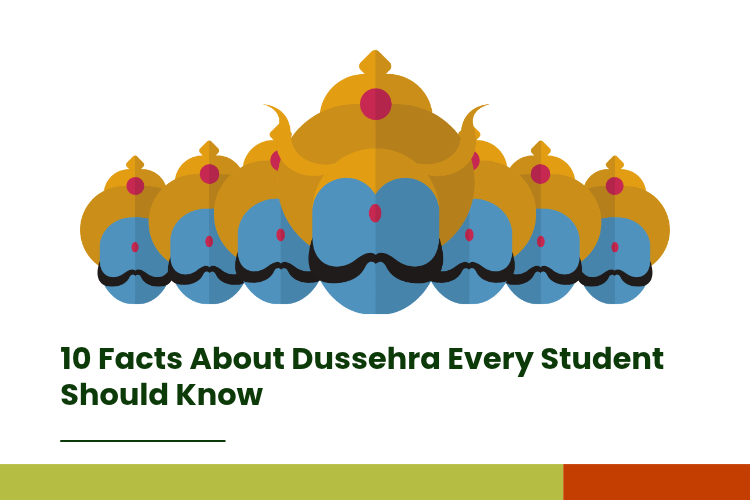
The most visually iconic Dussehra ritual is the burning of large effigies of Ravana (often alongside his brother Kumbhakarna and son Meghnad) in open grounds. This is typically accompanied by fireworks and marks the dramatic climax of local Ramlila performances.
5. Ramlila: A Living Dramatic Tradition
Ramlila — a multi-day dramatized retelling of the Ramayana — is performed in towns and cities across North India in the lead-up to Dussehra. The Ramlila of Ramnagar (Varanasi) is one of the oldest and most elaborate, running for nearly a month and drawing scholarly and cultural interest well beyond religious observance.
6. Vijayadashami: The Formal Name
While commonly called Dussehra (from “Dasha-hara,” meaning “removal of the ten,” referring to Ravana’s ten heads), the festival’s Sanskrit name — Vijayadashami — translates to “the victorious tenth day.” Both names refer to the same event but are used differently across regions and religious texts.
7. Mysuru Dasara: A Royal Tradition
In Karnataka, Dussehra takes the form of Mysuru Dasara, a nearly 400-year-old royal tradition featuring a grand procession with a bejewelled elephant carrying the idol of Goddess Chamundeshwari through the illuminated Mysuru Palace grounds. It’s one of the clearest examples of how Dussehra’s expression changes dramatically by region.
8. The Start of Festive Season
Dussehra is traditionally considered an auspicious day (“Sade Teen Muhurat” in some traditions) for starting new ventures, making major purchases, effectively opening the festive season that runs through Diwali.
9. Ayudha Puja: Worshipping Tools and Instruments
On the day before or during Dussehra in South India, Ayudha Puja involves worshipping tools, vehicles, machinery, and musical instruments — a tradition rooted in gratitude for the means by which people earn their livelihood, extending the festival’s themes beyond mythology into everyday life.
10. Global Cultural Recognition
In December 2021, UNESCO inscribed Kolkata’s Durga Puja — which culminates on Dussehra/Vijayadashami — on its Representative List of Intangible Cultural Heritage of Humanity, citing it as a festival that transcends religious boundaries and brings together artists, artisans, and communities.
Why This Matters for Students
Dussehra is frequently featured in school essays, cultural programs, and moral-science lessons because it encodes values — courage, righteousness, and the consequences of arrogance (through Ravana’s downfall) — in an accessible narrative form. We at K.R. Mangalam World School, Noida Extension believes that recognizing the festival’s regional diversity (Ramlila in the North, Durga Puja in the East, Dasara in the South) also helps students appreciate India’s cultural plurality rather than viewing Dussehra as a single, uniform celebration.
Final Takeaway
Dussehra is far richer than the single image of a burning effigy most students associate it with — it’s a festival built on two parallel legends, expressed through distinct regional traditions, and recognized today as a significant piece of global cultural heritage. Understanding these ten facts gives students a fuller, more accurate picture for essays, quizzes, or classroom discussions.
They refer to the same day and festival — Dussehra is the commonly used name (from “removal of the ten,” referencing Ravana’s ten heads), while Vijayadashami is the more formal Sanskrit name meaning “the victorious tenth day.”
Burning Ravana’s effigy symbolizes the destruction of evil, ego, and arrogance, marking Lord Rama’s victory over him at the end of the Ramayana’s climactic battle.
No — it varies significantly by region: effigy burning and Ramlila in North India, Durga Puja immersion in East India, and the royal Mysuru Dasara procession in Karnataka, among other regional traditions.
It falls on the tenth day (Dashami) of the bright fortnight of the Hindu lunar month of Ashwin, so the Gregorian calendar date shifts annually, usually between late September and mid-October.
Ayudha Puja is the ritual worship of tools, vehicles, and instruments, observed around Dussehra in South India as an expression of gratitude for one’s means of livelihood.
UNESCO added it to its Intangible Cultural Heritage list in 2021, recognizing it as a festival that unites artists, artisans, and communities across religious and social lines.