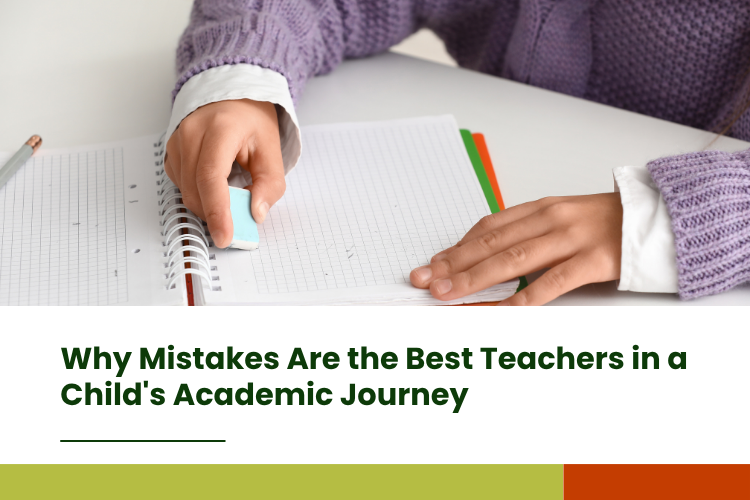
A child comes home with a test marked in red ink, or a science project that didn’t quite work, or a spelling word gotten wrong for the third time. The instinct — for parents and children alike — is to treat this as something to fix quickly and move past. But some of the most durable learning a child ever does happens in exactly this moment: not when they get it right, but when they get it wrong and have to work out why.
At K.R. Mangalam World School, Noida Extension, this is a principle woven into how classrooms are run: mistakes aren’t treated as failures to be hidden, but as data points that show a teacher — and the child — exactly where understanding is still forming.
The Science Behind Learning from Mistakes
There’s a well-documented cognitive reason mistakes stick better than easy correct answers: the brain engages more deeply when it has to reconcile an error than when it confirms something it already knew. Psychologists call this the “hypercorrection effect” — the more confident a student was in a wrong answer, the more strongly the correct answer is remembered once the mistake is pointed out.
This is why a child who struggles through a tricky long-division problem and gets it wrong twice before understanding their error often retains the method better than a child who was simply shown the correct steps from the start. The struggle itself is doing academic work.
What Mistakes Actually Teach
1. Problem-Solving Over Memorization
A wrong answer forces a child to ask “why didn’t this work?” — a question that memorization never requires. This is the beginning of analytical thinking, not just recall.
2. Resilience and Emotional Regulation
Learning to sit with the discomfort of being wrong, without giving up or spiraling into self-criticism, is one of the most transferable skills a school can help build. It shows up later in every setback outside the classroom too — a missed goal in sports, a rejected college application, a difficult first job review.
3. Self-Awareness
Mistakes are precise. A child who gets 7 out of 10 on a test doesn’t just know they need to “study more” — the specific three wrong answers tell them exactly which concept needs revisiting. This kind of targeted feedback is far more useful than a vague sense of doing “okay” or “not okay.”
4. Intellectual Courage
A child who is afraid of being wrong will often stop raising their hand, stop attempting the harder question, and stop trying the unfamiliar approach. A child who has learned that mistakes are survivable — even useful — will take the academic risks that lead to real growth: attempting the harder problem, offering an answer they’re not fully sure of, trying a new way to explain their thinking.
The Role of a Growth Mindset
Psychologist Carol Dweck’s research on “growth mindset” versus “fixed mindset” is directly relevant here. Children who believe intelligence and ability can be developed through effort tend to interpret a mistake as useful information — a signal of where to direct more effort. Children who believe ability is fixed tend to interpret the same mistake as proof of inadequacy — and often disengage rather than try again.
The difference isn’t the mistake itself. It’s the story a child has been taught to tell about it. This is exactly why the response from adults around a child — parents and teachers alike — matters more than the mistake does.
How Parents Can Respond to Mistakes at Home
- Separate the mistake from the child’s worth. “You got this wrong” is very different from “you’re bad at this.” Children absorb the framing far more than the fact.
- Ask before you explain. “What do you think went wrong?” invites the child to do the thinking, rather than simply receiving the correction.
- Normalize your own mistakes. Children learn a great deal from watching how adults respond when they get something wrong themselves — a burnt dinner, a wrong turn while driving, a typo in an email.
- Praise the process, not just the outcome. “You kept trying different approaches until one worked” reinforces effort and persistence far more effectively than “you’re so smart.”
- Resist the urge to fix it immediately. Give a child a few minutes to sit with a wrong answer and attempt a correction before stepping in — the attempt itself builds the skill.
How Teachers Build This Into the Classroom
- Reframing feedback as information, not judgment. Marking a wrong answer with a question (“What were you thinking here?”) rather than just a cross keeps the door open for the student to reason it through.
- Normalizing mistakes publicly. Teachers who share their own missteps — a miscalculation on the board, a word misspelled — model that expertise and error are not mutually exclusive.
- Building in low-stakes practice. Quizzes, drafts, and practice problems that don’t carry heavy grade weight give children room to make mistakes without high anxiety attached, which is where genuine experimentation happens.
- Celebrating effort and revision. A project that’s been revised after critical feedback often reflects more real learning than one that was correct on the first attempt — and recognizing that publicly shifts how students see revision itself.
A Word of Caution: Not Every Mistake Should Be Left Alone
Encouraging a healthy relationship with mistakes doesn’t mean ignoring patterns of repeated errors or leaving a child to struggle indefinitely without support. The goal is productive struggle — enough difficulty to engage real thinking, not so much that it becomes discouraging. Knowing when to let a child work through something and when to step in with guidance is part of what makes a good teacher’s — and a good parent’s — judgment valuable.
In Summary
A child’s academic journey isn’t measured by how few mistakes they make, but by what they do with the ones they do make. Every wrong answer is an opportunity in disguise — a precise, personal signal of exactly what to learn next. Raising and teaching children to see mistakes this way, rather than as something to fear or hide, is one of the most valuable habits of mind a school and a family can build together.
At K.R. Mangalam World School, Noida Extension, this philosophy shapes classroom culture at every level — because the students who grow the most aren’t the ones who never stumble, but the ones who’ve learned exactly how to get back up.