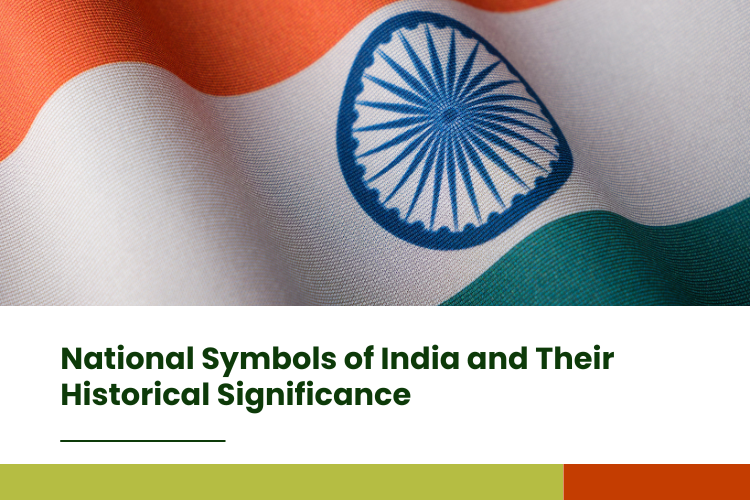
India’s national symbols are more than familiar images, songs, animals or objects. Each one represents an important part of the country’s history, constitutional identity, cultural inheritance or natural heritage. Together, they communicate the ideals of unity, courage, truth, dignity and progress.
For students, learning about the national symbols of India should go beyond memorising names for an examination. Understanding when these symbols were adopted, why they were selected and what they represent helps young people connect with India’s journey from an ancient civilisation to an independent democratic republic.
Why Do National Symbols Matter?
India is home to numerous languages, faiths, customs and regional traditions. National symbols create a shared vocabulary through which citizens can express their collective identity.
They perform several important roles:
- They represent India at national and international events.
- They connect the modern republic with its historical roots.
- They recall the sacrifices associated with the freedom struggle.
- They reflect India’s cultural and ecological diversity.
- They encourage citizens to uphold constitutional values.
- They promote respect, unity and responsible citizenship.
Some symbols are governed by specific laws and official protocols. Others have become nationally significant because of their historical, cultural or environmental importance.
National Symbols of India: A Quick Guide
| National symbol | Official identity | Historical significance |
|---|---|---|
| National Flag | Tiranga | Represents independence, unity and constitutional ideals |
| State Emblem | Lion Capital of Ashoka | Connects modern India with ethical governance and truth |
| National Anthem | Jana Gana Mana | Celebrates India’s unity across regions |
| National Song | Vande Mataram | Inspired national consciousness during the freedom struggle |
| National Animal | Royal Bengal Tiger | Represents strength and India’s wildlife heritage |
| National Bird | Indian Peacock | Reflects beauty, grace and cultural continuity |
| National Calendar | Saka Calendar | Created a standard system for official civil use |
| Currency Symbol | ₹ | Combines Indian and international visual identities |
| National River | Ganga | Represents India’s civilisational and ecological heritage |
| National Aquatic Animal | Ganges River Dolphin | Draws attention to river health and conservation |
1. The National Flag: The Tiranga
India’s National Flag was adopted by the Constituent Assembly on 22 July 1947, shortly before the country gained independence. Its design developed from the freedom movement, during which different flags were used to represent the growing demand for self-rule.
The Tiranga consists of three horizontal bands: India saffron at the top, white in the middle and India green at the bottom. At the centre is a navy-blue Ashoka Chakra with 24 spokes.
Saffron represents strength and courage, white signifies peace and truth, and green reflects fertility, growth and the relationship between people and the land. The Ashoka Chakra is based on the Dharma Chakra associated with Emperor Ashoka. Its wheel suggests law, movement and continuous progress.
The flag’s adoption marked India’s emergence as a free nation.
2. The State Emblem: The Lion Capital of Ashoka
India’s State Emblem is adapted from the Lion Capital erected by Emperor Ashoka at Sarnath during the third century BCE. The original sculpture features four lions standing back-to-back, although only three are visible in the two-dimensional representation.
The emblem was adopted on 26 January 1950, the day India became a republic. Beneath it appears the national motto, “Satyameva Jayate,” meaning “Truth Alone Triumphs.” The phrase comes from the Mundaka Upanishad.
Historically, the emblem connects the Republic of India with Ashoka’s principles of Dharma, ethical authority and public welfare. The lions communicate courage, confidence and strength, while the Dharma Chakra represents righteous action.
Unlike an ordinary decorative logo, the State Emblem is a legally protected symbol. Its official use is regulated to preserve its authority and dignity.
3. The National Anthem: Jana Gana Mana
“Jana Gana Mana” was composed by Rabindranath Tagore and first publicly sung at the Calcutta Session of the Indian National Congress in December 1911. Its Hindi version was adopted by the Constituent Assembly as India’s National Anthem on 24 January 1950.
The anthem invokes different regions and landscapes, presenting India as one nation united across geography and culture. Its historical importance lies in its inclusive vision of national belonging.
4. The National Song: Vande Mataram
“Vande Mataram” was written in Sanskrit by Bankim Chandra Chattopadhyay and appeared in his novel Anandamath. The title means “I bow to thee, Mother,” presenting the motherland through vivid images of natural beauty.
The song became a powerful expression of resistance during the freedom movement. It was sung at political gatherings and inspired people participating in the struggle against colonial rule.
Its importance, therefore, lies not only in its literary quality but also in its role in awakening national consciousness. While “Jana Gana Mana” is the National Anthem, “Vande Mataram” is recognised as the National Song. Both occupy distinct and respected places in India’s national life.
5. The National Animal: Royal Bengal Tiger
The Royal Bengal Tiger represents strength, agility, endurance and grace. It is also an important part of India’s forests and ecological systems.
The tiger’s national status carries an environmental message. Its survival depends on healthy forests, sufficient prey and protected habitats. Conserving tigers consequently helps protect many other species that share the same ecosystem.
The launch of Project Tiger in 1973 marked an important stage in India’s conservation history. For students, the tiger is not merely a symbol of power; it is also a reminder that national pride must be accompanied by environmental responsibility.
6. The National Bird: Indian Peacock
The Indian Peacock, or Pavo cristatus, was declared the National Bird in 1963. Native to the Indian subcontinent, it is recognised for its colourful plumage, graceful form and distinctive display.
Peacocks appear in Indian sculpture, painting, folklore, poetry and religious traditions. Their presence across cultural forms made the bird a meaningful representation of India’s artistic and natural heritage.
As a protected species, the peacock also reminds citizens that admiration for national symbols should lead to responsible conservation rather than disturbance or exploitation.
7. The National Calendar: Saka Calendar
India adopted the Saka Calendar for official civil purposes on 22 March 1957. It is used alongside the Gregorian calendar in government communications, calendars issued by the Government of India and broadcasts by All India Radio.
The calendar begins with the month of Chaitra. Its adoption followed the work of the Calendar Reform Committee, which examined India’s numerous regional calendar systems and recommended a standardised national framework.
The Saka Calendar reflects India’s scientific and astronomical traditions while providing administrative consistency.
8. The Indian Rupee Symbol
The Indian rupee symbol—₹—was officially adopted in 2010. Designed by D. Udaya Kumar, it combines the Devanagari letter “र” with the Roman capital letter “R” without its vertical stem.
The parallel lines at the top evoke the Indian tricolour while also resembling the equality sign. This gives the design both cultural meaning and a modern visual identity.
Its adoption placed the Indian rupee alongside internationally recognisable currency symbols such as the dollar, pound, euro and yen. It represents India’s economic identity in an increasingly connected world.
9. The Ganga and the Ganges River Dolphin
The Ganga has shaped settlements, agriculture, beliefs, literature and livelihoods for centuries. Recognised as India’s National River, it represents both civilisational continuity and ecological responsibility.
The Ganges River Dolphin was declared the National Aquatic Animal to highlight the need to protect India’s freshwater ecosystems. Because the dolphin requires a healthy river environment, its presence serves as an indicator of river health.
Together, these two symbols teach an important lesson: heritage cannot be respected only through words. Rivers must also be protected from pollution, habitat destruction and unsustainable use.
How Students Can Learn Beyond Memorisation
National symbols become more meaningful when students investigate their stories. Timeline-making, emblem analysis, flag-protocol demonstrations, quizzes and conservation projects can turn a factual lesson into active learning.
At K.R. Mangalam World School, Noida Extension, the best CBSE school in Greater Noida West, students are encouraged to explore the historical ideas, constitutional values and environmental responsibilities associated with national identity. Such learning helps children understand that respecting national symbols involves responsible conduct—not simply recognising them in a textbook.
Conclusion
The national symbols of India form a bridge between the country’s past, present and future. The Tiranga recalls independence, the State Emblem represents truth and ethical governance, patriotic compositions preserve the spirit of the freedom movement, and natural symbols highlight India’s ecological wealth.
Understanding their historical significance helps students see these symbols as living expressions of national values. When young citizens learn the facts behind them and practise the principles they represent, national pride becomes thoughtful, informed and responsible.