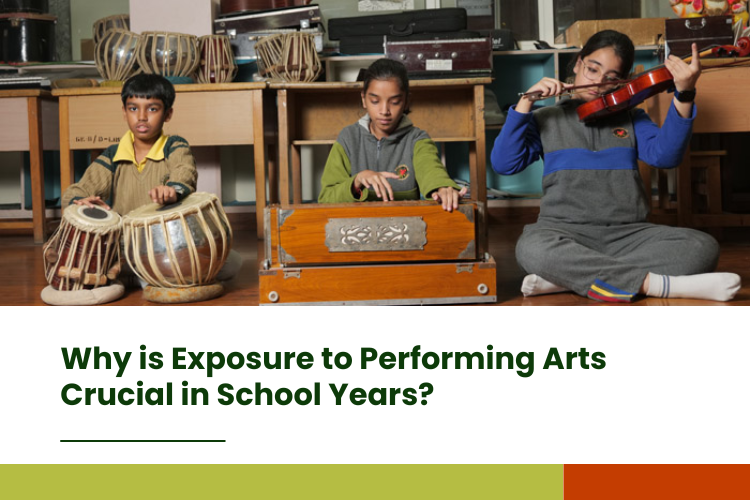
When children begin their academic journey, the focus of most parents remains largely on their child’s intellectual and overall academic growth. This is pretty normal and quite reasonable. However, not much consideration is given to the fact whether their children are also being provided with adequate exposure to performing arts. At K.R. Mangalam World School, Noida Extension, the leading CBSE school in Greater Noida West, we firmly believe that exposure to performing arts is equally important as academic exposure during the school years because it quietly develops life skills that textbooks alone cannot build.
As such, parents shouldn’t treat performing arts as optional add-ons that children should explore only in their free time. Instead, it should become an integral part of their daily learning routine.
If you’re wondering why children should be introduced to performing arts in their school years, this blog post will clear all your doubts. So, read till the end.
Performing Arts: Things Parents Must Know
In modern school settings, performing arts usually include music (both vocal and instrumental), dance in its various forms, theatre or drama, and activities such as storytelling or public speaking. In fact, in most of the schools today, performing arts activities are integrated into the curriculum to help students develop real-life skills.
As students continue participating in these activities, they gradually learn to use their voices, bodies, and emotions to communicate their ideas and feelings. Such expressions are rarely developed in traditional classroom settings. These experiences contribute massively to a child’s holistic development.
Why Exposure to Performing Arts Matters in School Years?
Some people may argue that school years should be reserved solely for academic growth and that exposure to the performing arts can distract students from their studies.
While these are valid arguments, we at K.R. Mangalam World School, Noida Extension, have witnessed in our years of experience in the education domain that when children are exposed to performing arts during their school years, it begins showing up in their personality and aids in forming their identity. In this phase, children start to understand:
- Who they are
- How they fit into social environments
- How comfortable they feel expressing themselves
If a child grows up without opportunities to express, perform, or even face a small audience, hesitation often becomes a habit. It can manifest later in adulthood as stage fright, difficulty speaking up in social settings, and even a lack of confidence. With early exposure to performing arts, you can prevent all these situations.
Exposure to Performing Arts is Conducive to Your Child’s Overall Growth
If you’re still unsure whether exposing children to performing arts in school years is a good idea, the following points will clear your doubts:
Builds Real Confidence, Not Just Stage Confidence
With repeated exposure to performing arts, children don’t just become comfortable on stage; they also build a deeper kind of confidence.
For instance, when our students consistently participate in our dance classes and then stand in front of a small audience to perform, it helps them build the confidence and courage needed to face others. It helps them interact more effectively at social gatherings, professional meet-ups, and other settings where they need to engage with others.
At K.R. Mangalam World School, Noida Extension, regarded as the best CBSE school in Greater Noida, we offer both music and dance classes to help our students build unshakable confidence.
Strengthens Communication in a Natural Way
Some people limit communication to the art of speaking well. In reality, it also involves clarity, expression, active listening, and commanding a strong presence. Performing arts develop all these skills naturally.
Different activities improve different aspects of communication. For example, participating in theatre plays can improve your kid’s voice modulation and pronunciation, while dancing can improve their overall body language.
At K.R. Mangalam World School, Noida Extension, we firmly believe that exposure to performing arts is essential for anyone who struggles to express themselves verbally. These media become their starting point, helping them communicate better. Children who hesitate to express themselves verbally may find it easier to do so through movement, rhythm, and role-play. With time, children learn to carry this confidence into verbal communication as well.
Teaches Focus, Discipline, and Patience
These are the least obvious benefits of participating in performing arts activities. Whether a child decides to learn a musical instrument or ace a particular dance form, everything demands discipline for sustained results. Over time, these processes will train children to focus deeply on a task, often for extended periods.
Since we’re living in highly distracting environments, the ability to concentrate and remain disciplined has become immensely valuable. Most importantly, it also teaches students that improvements don’t happen instantly; they take patience, effort, and persistence.
Develops Emotional Intelligence
Children experience many emotions during their growing-up years, but it is not uncommon for them to struggle to understand and express them. It is where performing arts come to their rescue.
For instance, music lets them connect with feelings subtly, and dance gives them a physical outlet for emotions that might otherwise remain unexpressed.
Hence, consistent participation in performing arts activities is the most practical way to make a child emotionally intelligent. This single skill can empower your kids to handle stress, build relationships, and respond thoughtfully in risky situations.
Frequently Asked Questions (FAQs):
What if my child is shy or unwilling to participate in performing arts?
That’s completely normal. You should try to introduce your kids to low-pressure activities, such as storytelling, first. It will gradually build their confidence to participate in other performing arts activities, such as dance and music.
Do performing arts help children in future careers?
Yes, they help indirectly. They instil and sharpen real-life skills, such as communication, confidence, teamwork, etc., that can help them succeed in their chosen career.
At what age should children start participating in performing arts?
Children should ideally be introduced to performing arts once they enter primary school.
How much time should children spend on performing arts?
Kids with a busy schedule should keep aside 30-40 minutes from their daily routine for performing arts activities.
Conclusion
Exposure to performing arts in school years isn’t just about learning a skill. It’s more about shaping a child’s personality. We firmly believe that consistently participating in these activities can make your kids more confident, expressive, emotionally aware, and resilient.
At K.R. Mangalam World School, Noida Extension, a well-known CBSE school in Greater Noida West, we’ve integrated performing arts into our curriculum for the same reason. Enrol your kids in our school if you want them to benefit from a structured, gradual exposure to performing arts activities without affecting their academic growth.