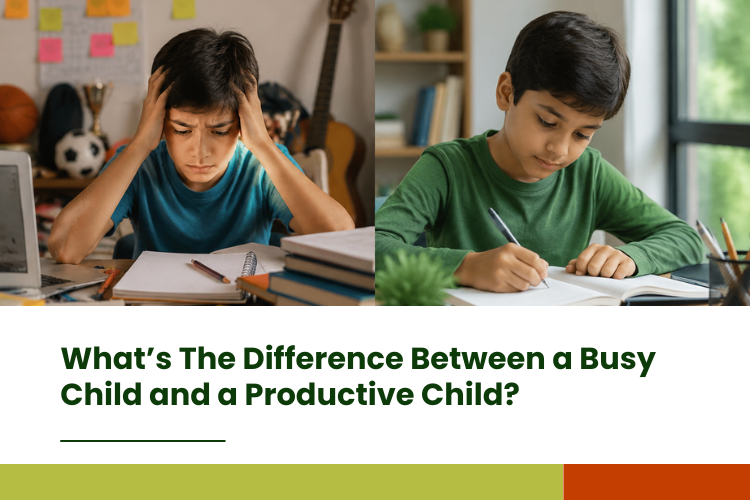
Children today are busier than ever. From school hours to homework and sports sessions to music lessons, their daily schedule is packed from start to end. In fact, in some cases, their routine rivals that of several adults. When parents see their kids engaged in numerous activities, they may feel their kids are learning a lot and growing well. However, only a few pause to reflect whether their kids are actually learning something meaningful or merely ticking off boxes on their daily to-do list. This simple observation can help you understand if your child is merely busy or actually productive.
In this regard, we at K.R. Mangalam World School, Noida Extension, recognised as the best school in Noida Extension, firmly believe that every parent should ideally undergo this introspection. It will help you determine the real difference between being busy and productive. To make it easier, we’ve created this blog post that will make the distinction easier. If your child is not being productive, you can gently bring them back on the right track.
A Busy Child Focuses on Activity; A Productive Child Focuses on Growth
The most fundamental difference lies in what is being measured. A busy child is often evaluated by the number of activities completed, whereas a productive child is evaluated by growth.
As a parent, you may initially feel satisfied when you see your kids attending multiple classes, finishing assignments, and participating in competitions. Basically, the more they remain occupied, the better. However, in such cases, the focus shifts silently from what the child gained from those experiences to how much time they spent on different activities.
A productive child doesn’t waste time in random activities. Instead, they ask themselves what they learned at the end of the day. Did they learn a new skill or improve an existing one? Did they develop confidence or gain a deeper understanding of a subject?
If you look closely, it’s pretty much easy to distinguish between a busy and productive child by mere observation. Doing multiple activities can create the appearance of progress, but growth provides evidence of it.
A Busy Child Completes Tasks; A Productive One Understands the Purpose Behind Doing It
We at K.R. Mangalam World School, Noida Extension, the best school in Noida Extension, have noticed that many children nowadays have started becoming accustomed to completing tasks because they’re instructed to do so. They will finish worksheets, attend classes, submit projects, and even practice skills, but all of this without fully understanding why those activities matter.
Their attention is fixed on ‘completing’ the activities rather than understanding the reasons for doing them. Productive children function entirely differently. They understand the purpose behind what they’re doing. And when a child begins to take an interest in understanding the purpose before doing any activity, they become more engaged in the process. Here, they’re not simply checking tasks off a list. Instead, they’re working towards meaningful improvement.
A Busy Child Consumes Time; A Productive Child Creates Progress
Some parents assume that if a child spends more time doing an activity, it’s a confirmation of growth. However, time alone is a poor indicator of learning. If a child spends three hours studying while remaining distracted, they are simply being busy without much real output.
A productive child may spend fewer hours studying, but they’ll ensure they use that limited time wisely. In this limited time, they may try to develop conceptual clarity and identify weak areas. Such kids are more likely to make genuine progress in life.
Productive children naturally convert time into meaningful learning and improvements. Busy children will convert time into activity completion without obtaining any comparable benefits.
A Busy Child Depends on External Direction; A Productive Child Takes Ownership
Another easy way to distinguish between a busy and productive child is to check whether they work independently or rely entirely on external instructions. Busy kids usually rely heavily on adults to structure every aspect of their day. Their parents, teachers, and coaches decide what must be done and when it must be completed.
Busy children usually follow external instructions, but they fail to play a commanding role in their own development. Productive children work on an entirely different principle. They develop a sense of ownership over their day-to-day activities early in life. They’ll understand their key goals, monitor progress, and become active participants and shapers of their own learning journey.
This ownership is very important because success in school and life increasingly depends on self-management. Children who learn to take responsibility for their growth from a young age are often better prepared to succeed in real life.
Frequently Asked Questions (FAQs)
- Can a child be both busy and productive?
Yes, they can. A child can have a full schedule yet remain productive if every activity contributes to their learning, growth, and skill development.
- Are having multiple extracurricular activities harmful for children?
It depends on what activities you’ve chosen for your kids. If all the activities align with the child’s natural interests and meaningfully contribute to their holistic growth & development, then they aren’t harmful. However, you should still limit the number of activities to two or three (maximum).
- How can parents tell if a child is productive or busy?
The best way is to evaluate whether the child has learned something from the activity they’ve performed. If the activity has helped them gain real knowledge or build a skill, then the child is productive. If you cannot notice any real improvement, then it’s simply being busy.
Conclusion
Every parent wants to see their children grow and succeed, but it cannot be achieved by making them superficially busy. At K.R. Mangalam World School, Noida Extension, regarded as a top CBSE school in Noida Extension, we believe that children shouldn’t be kept unnecessarily busy. While activities, classes, and structured experiences can support a child’s development, their true growth depends on the quality of their learning.
Instead, the focus should be on making children productive in the true sense of the term. If you’re unsure how to achieve it, start by encouraging them to understand the purpose behind every activity. Teach them how to reflect on their experiences and take ownership of their development. Only by shifting the focus from activity to growth can children unleash their true potential and begin to gain maximum benefits.